Choosing a living room rug sounds easy until you are staring at a 5′ × 7′, 6′ × 9′, 8′ × 10′ and 9′ × 12′ option online and wondering whether any of them will actually work with your sofa.
I have seen beautiful living rooms with lovely furniture, good lighting and carefully chosen décor that still feel slightly disconnected. Very often, the rug is the problem. It may be too small, turned in the wrong direction or placed so far away from the furniture that everything appears to be floating around it.
The frustrating part is that the smallest rug is usually the least expensive, so it can be tempting to choose it and hope for the best. Unfortunately, a rug that is too small can make an entire seating arrangement feel smaller and less balanced—even when the rug itself is beautiful.
The good news is that choosing the right living room rug size becomes much easier once you measure the furniture arrangement, not simply the room.
In this guide, I am sharing how to choose a rug for a sofa, loveseat, sectional, small living room or open-concept space. I will also explain how much furniture should sit on the rug, how to measure before ordering and what to consider when choosing the material and colour.
Disclosure: This post contains affiliate links. As an Amazon Associate I earn from qualifying purchases at no extra cost to you.
A properly sized rug is one of the best places to use your decorating budget because it visually anchors everything around it. For more ideas about deciding where to save and where to spend, read my guide to decorating your home on a budget without making it look cheap.
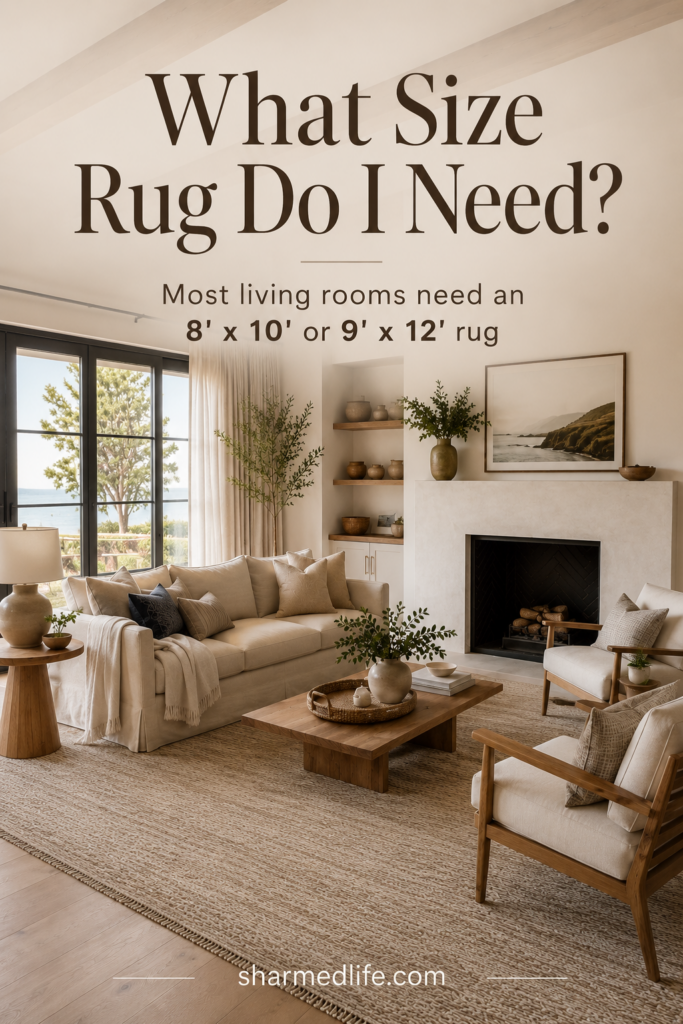
Quick Answer: What Size Rug Works in Most Living Rooms?
For many average living rooms, an 8′ × 10′ or 9′ × 12′ rug is the best starting point. The rug should generally extend beyond both ends of the sofa and sit underneath at least the front legs of the sofa and nearby chairs.
A 5′ × 7′ rug is usually better suited to a very small seating area, reading nook or intentional layered-rug arrangement than a full-size sofa-and-chair layout.
My simplest advice is this:
Measure the complete seating area, tape the rug dimensions onto the floor and compare at least two sizes before ordering.
A rug can look surprisingly large when it is rolled up or shown by itself online. Once it is placed underneath a full sofa, coffee table and chairs, it often looks much smaller than expected.
I added a few neutral rugs, rug pads and helpful measuring tools to my Amazon storefront so they are easier to compare in one place. Prices and availability can change quickly, especially during Prime Day, so always check the current details on Amazon before purchasing:
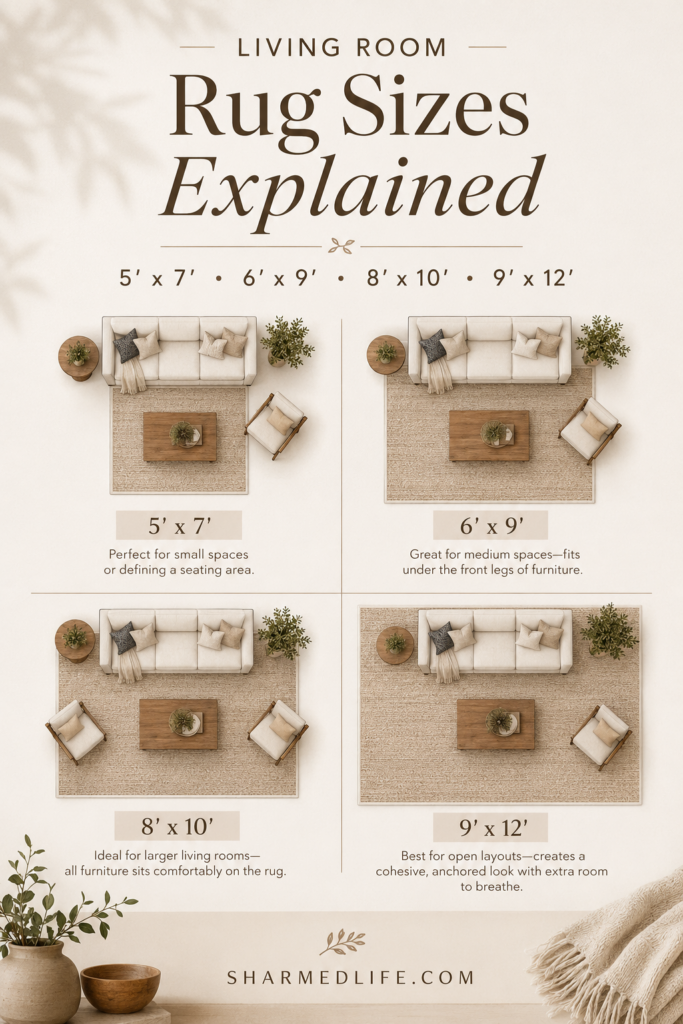
Living Room Rug Size Guide at a Glance
The following sizes are useful starting points. Your furniture arrangement is more important than the room measurements alone, but this quick guide can help you narrow down your options.
4′ × 6′ rug
A 4′ × 6′ rug is best for:
- A small reading nook
- Two compact chairs and a side table
- A small accent area
- Layering over a larger neutral rug
- A compact apartment seating arrangement
It will usually be too small to anchor a standard sofa and chairs.
5′ × 7′ rug
A 5′ × 7′ rug may work for:
- A loveseat
- A compact apartment
- A small coffee-table area
- Two chairs in front of a fireplace
- A layered-rug arrangement
This size can work when no furniture legs touch the rug, but the placement needs to look intentional. It is often too small when placed in the middle of a full-size living room with only the coffee table sitting on it.
6′ × 9′ rug
A 6′ × 9′ rug is often suitable for:
- A small living room
- A loveseat and one or two compact chairs
- A sofa in a narrow room
- A smaller conversation area
Try to position at least the front sofa legs on the rug. If the rug ends inside the width of the sofa, compare it with an 8′ × 10′ before making your final decision.
8′ × 10′ rug
An 8′ × 10′ rug works well in many average living rooms with:
- A standard sofa
- A coffee table
- One or two accent chairs
- A compact sectional
- A seating arrangement positioned near a wall
This is one of the first sizes I would tape out for a typical living room.
9′ × 12′ rug
A 9′ × 12′ rug is often a better choice for:
- A larger living room
- A sofa with two substantial accent chairs
- Many sectional arrangements
- Furniture that floats away from the walls
- Open-concept living spaces
The larger size gives the furniture more room to sit comfortably on the rug and creates a more unified seating zone.
10′ × 14′ rug
A 10′ × 14′ rug is best for:
- Oversized sectionals
- Large living rooms
- Spacious open floor plans
- Arrangements where all furniture legs sit on the rug
This size can create a beautiful, substantial foundation, but it needs enough surrounding floor space so it does not look like wall-to-wall carpet.
Disclosure: This article includes affiliate links. As an Amazon Affiliate, I earn from qualifying purchases at no extra cost to you.
[SHOP 6′ × 9′ NEUTRAL RUGS — Amazon 6×9 rug]
[SHOP 8′ × 10′ NEUTRAL RUGS — Amazon 8×10 rug]
[SHOP 9′ × 12′ NEUTRAL RUGS — Amazon 9×12 rug]
Now that you have a starting size in mind, the next step is making sure it works with your actual furniture.
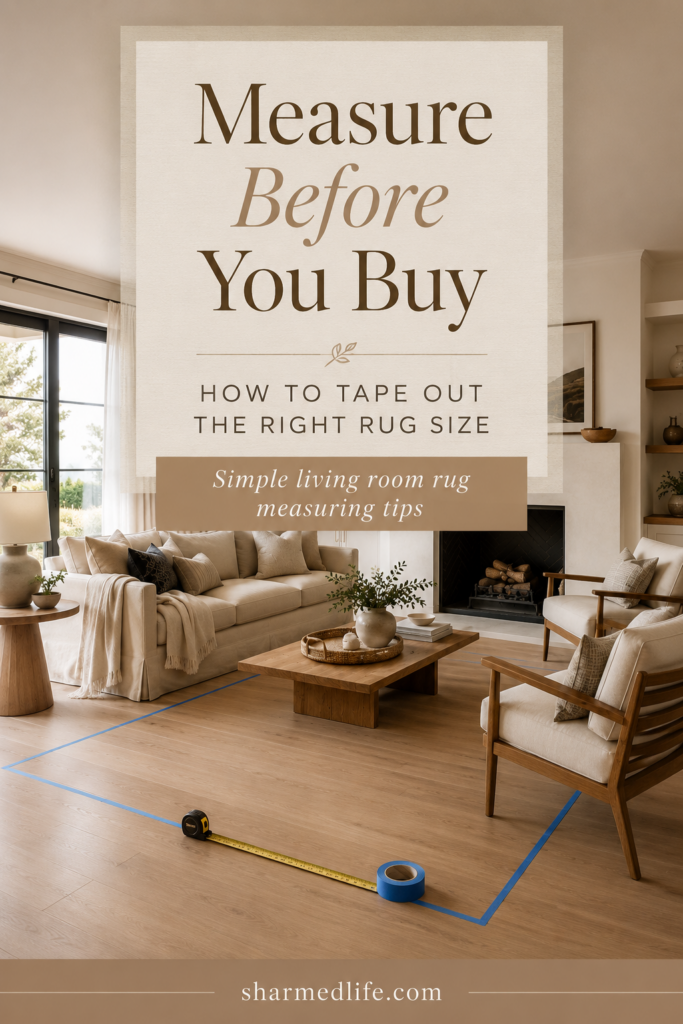
How to Measure Your Living Room Before Buying a Rug
One of the biggest rug-buying mistakes is measuring the room but forgetting to measure the sofa and seating arrangement.
A living room may be 12 feet wide, but that does not automatically tell you whether you need an 8′ × 10′ or 9′ × 12′ rug. The answer depends on the size and position of the furniture.
Measure your sofa first
Measure the sofa from one outside arm to the other.
Write down:
- The full sofa length
- The sofa depth
- The length of a chaise, if you have one
- The distance between the sofa and chairs
- The total width of the complete seating arrangement
The rug should generally be wider than the sofa. When the rug stops inside the width of the sofa arms, it can make the whole arrangement feel squeezed.
Measure the complete seating zone
If you have a sofa and two chairs, measure from the outside edge of one chair to the outside edge of the other.
In an open-concept room, focus on the living-room zone rather than trying to cover the entire open floor. The rug should define the conversation area and separate it visually from the dining room, kitchen or walkway.
Use painter’s tape to outline the rug
This is one of the easiest ways to prevent an expensive return.
Tape the rug measurements directly onto the floor. Start with an 8′ × 10′ outline and then expand the tape to show a 9′ × 12′.
Stand at the main entrance to the room and check:
- Does the rug extend beyond both ends of the sofa?
- Will the front legs of the chairs reach the rug?
- Is there enough visible flooring around it?
- Can nearby doors open properly?
- Does the rug interfere with floor vents?
- Does the seating arrangement look connected?
Take a photo of each taped outline. Scale problems can be much easier to notice in a photograph than when you are standing in the room.
Check the rug’s orientation
In many standard living rooms, the long side of the rug should run in the same direction as the sofa.
Turning a rectangular rug the wrong way can make the room appear narrow or cause the rug to stop before it reaches the accent chairs.
Helpful measuring supplies
[SHOP A LONG MEASURING TAPE — https://amzn.to/4vlJ7Cr]
[SHOP PAINTER’S TAPE — https://amzn.to/4etlMra]
[SHOP FURNITURE SLIDERS — https://amzn.to/44lMgpO]
Once you know which dimensions fit, the next question is how much of the furniture should actually sit on the rug.
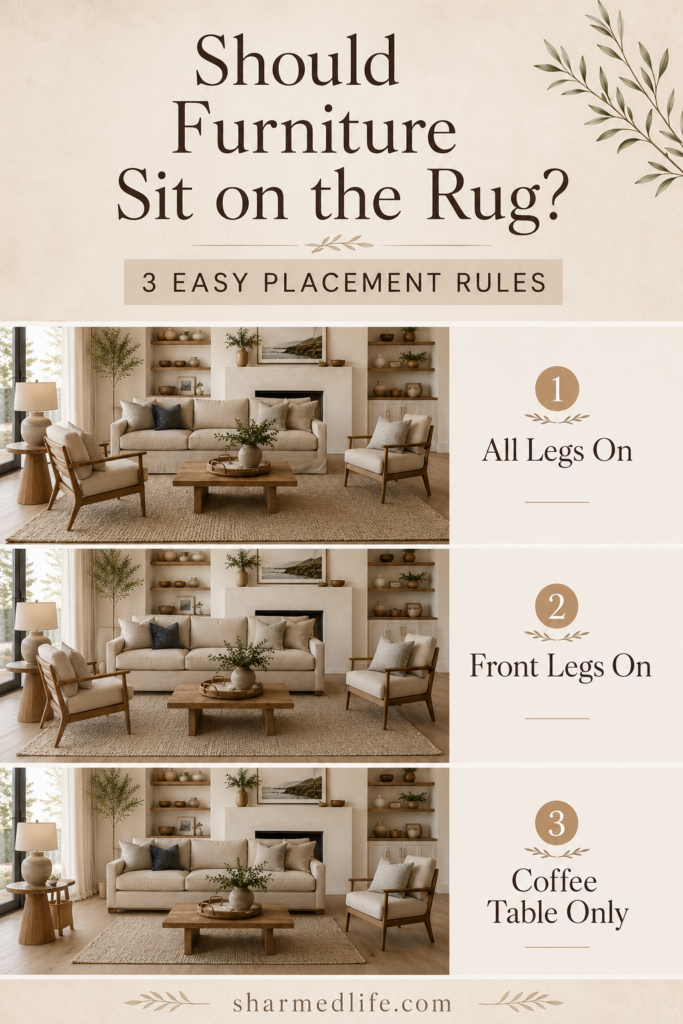
Should Living Room Furniture Sit on the Rug?
There are three common living-room rug placements. The right choice depends on the size of the room, the furniture arrangement and the rug.
Option 1: All Furniture Legs on the Rug
With this arrangement, the sofa, chairs and coffee table sit completely on the rug.
This works especially well in:
- Large living rooms
- Open-concept spaces
- Rooms with floating furniture
- Formal conversation areas
- Rooms using 9′ × 12′, 10′ × 14′ or larger rugs
The rug should be large enough that the furniture does not look crowded near its edges. Ideally, there should be some rug visible behind and beside each piece.
This layout can make a large room feel grounded and intentional because the rug clearly contains the entire seating area.
Option 2: Front Furniture Legs on the Rug
This is the arrangement I would use in many average living rooms.
The front legs of the sofa and chairs sit on the rug while the back legs remain on the floor.
This works well with:
- Standard sofas
- Sofas placed near a wall
- 8′ × 10′ and 9′ × 12′ rugs
- Sofa-and-two-chair arrangements
- Medium-size living rooms
The rug visually connects the seating without having to extend completely underneath every piece.
Try to keep the placement consistent. If the sofa’s front legs are on the rug, the nearby chairs should also touch it whenever possible.
Option 3: Only the Coffee Table on the Rug
This arrangement can work in:
- Very small rooms
- Reading nooks
- Compact apartments
- Deliberate layered-rug arrangements
- Spaces using a decorative accent rug
However, it is also the arrangement most likely to make a full living room rug look undersized.
I would not automatically choose a small rug simply because it is less expensive. If the rug appears to be floating underneath the coffee table while every seating piece sits far away from it, the room may feel more disconnected.
A front-legs-on arrangement is usually the easiest choice, but the final rug size still depends on the type of sofa you own.
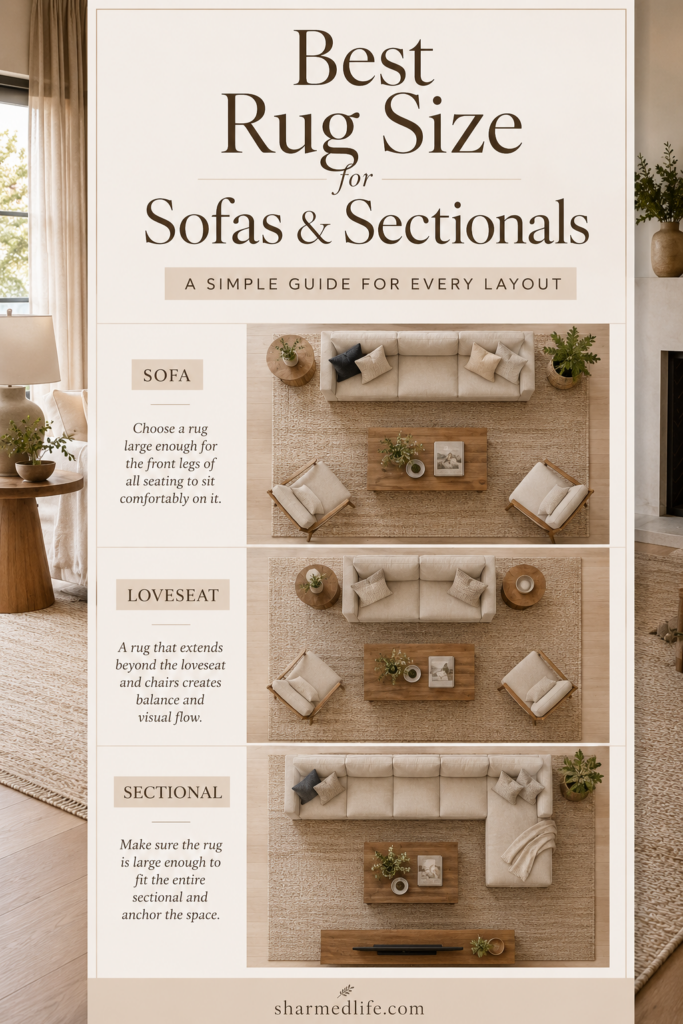
What Size Rug Should I Use With My Sofa?
Standard Sofa With a Coffee Table
For a standard sofa-and-coffee-table arrangement, I would usually compare an 8′ × 10′ rug with a 9′ × 12′ rug.
The 8′ × 10′ may be enough when:
- The sofa is near a wall
- The room is average in size
- The chairs are compact
- Only the front legs need to sit on the rug
The 9′ × 12′ may be better when:
- The sofa is long
- The chairs sit farther apart
- The room is open and spacious
- You want more furniture sitting on the rug
- The 8′ × 10′ stops inside the sofa width
The rug should extend beyond both ends of the sofa rather than ending directly beneath the sofa arms.
Sofa With Two Accent Chairs
When a sofa is paired with two chairs, measure the complete width of all three seating pieces.
The rug needs to visually connect the chairs to the sofa. If the front chair legs cannot reach the rug, the arrangement may feel divided into separate pieces.
An 8′ × 10′ may work in a tighter room. A 9′ × 12′ often provides more breathing room when the chairs are larger or angled.
Loveseat or Small Living Room
A loveseat may work with:
- A 5′ × 7′ rug in a very compact nook
- A 6′ × 9′ rug in a small living room
- An 8′ × 10′ rug when the seating area includes chairs or more floor space
A small room does not always need the smallest rug.
Sometimes a larger rug makes a compact living room feel more unified because it creates one clear seating area instead of several small visual sections.
Sectional Sofa
Sectionals need to be measured carefully because their dimensions vary so much.
A compact sectional may work with an 8′ × 10′. A larger sectional may need a 9′ × 12′ or 10′ × 14′.
Look at the full footprint of the sectional, including the chaise.
You have several placement choices:
- Place all sectional legs on the rug
- Place the front sectional legs on the rug
- Position the rug inside the open “L” shape while still extending beyond the coffee table
The rug should look connected to the sectional rather than lost inside it.
Sofa Against the Wall
The rug does not need to extend all the way to the wall.
Its job is to connect the sofa, coffee table and nearby chairs. Leaving some floor visible behind the sofa legs is completely fine.
Open-Concept Living Room
In an open-concept space, the rug creates a visual boundary.
Use it to define the living area without letting it drift awkwardly into the dining space or main walkway.
The sofa and chairs should appear to belong to the rug. The dining furniture should have its own separate arrangement.
Once the overall size is right, a few small placement mistakes can still affect how the room looks.
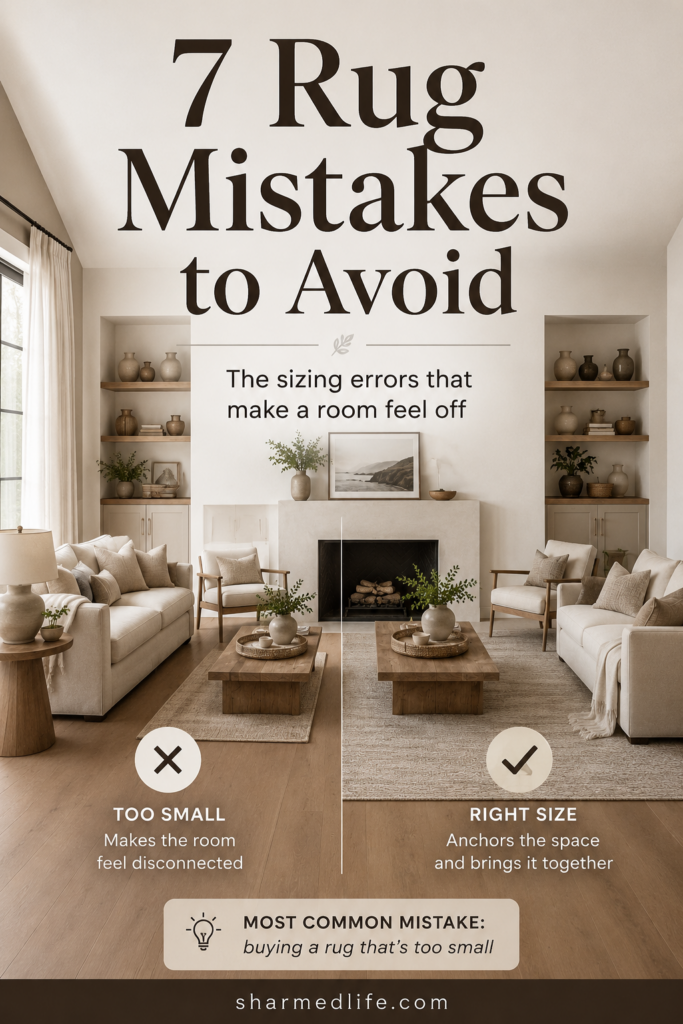
Seven Common Living Room Rug Mistakes
1. Buying the Smallest Rug to Save Money
This is understandable because the price difference between sizes can be significant.
However, buying a 5′ × 7′ rug for a room that needs an 8′ × 10′ may make the entire seating area feel smaller. It can also mean replacing the rug later, which is not much of a bargain.
2. Choosing a Rug Narrower Than the Sofa
A rug that ends well inside both sofa arms may look pinched.
Choose a size that extends beyond the sofa so it frames the seating arrangement rather than disappearing beneath it.
3. Placing the Rug Too Far From the Sofa
The rug should touch the furniture arrangement.
A large gap between the rug and sofa makes them look unrelated, even when both pieces are beautiful.
4. Turning the Rug in the Wrong Direction
The long edge of a rectangular rug will usually run parallel to the sofa.
Before ordering, check the actual orientation of the dimensions. An 8′ × 10′ rug can appear completely different when the long side runs in the wrong direction.
5. Choosing Colour Before Size
It is easy to become distracted by the perfect faded pattern or warm neutral colour.
Choose the correct size first. The most beautiful pattern will not fix proportions that are wrong for the room.
6. Forgetting Doors, Vents and Walkways
Check nearby:
- Patio doors
- Closet doors
- Floor vents
- Fireplace hearths
- Hallway openings
- Room transitions
A thick rug placed too close to a door can quickly become frustrating.
7. Skipping the Rug Pad
A rug pad can add grip, cushioning and protection.
The pad should be slightly smaller than the rug so it remains hidden beneath the edges.
Useful rug accessories
[SHOP A CUSHIONED RUG PAD — https://amzn.to/4abYR2t]
[SHOP NON-SLIP RUG GRIPPERS — https://amzn.to/4oCECRj]
[SHOP A PORTABLE SPOT CLEANER — https://amzn.to/4guVx6b]
With the practical measurements finished, you can move on to the part that makes the rug feel right for your actual life: the material.
What Type of Living Room Rug Is Best for Real Life?
The best living-room rug is not simply the prettiest one. It also needs to suit the amount of traffic, cleaning and everyday use the room receives.
Washable Low-Pile Rugs
Washable rugs can be a practical choice for:
- Busy family rooms
- Homes with pets
- Homes with children
- Food and drink spills
- High-traffic living areas
They are usually thinner than traditional rugs, so they may feel better with a cushioned rug pad underneath.
Before buying, check the care instructions carefully. “Washable” does not always mean every large size fits easily into a standard home washing machine.
Wool and Wool-Blend Rugs
Wool rugs often feel substantial and soft underfoot.
They may work well in:
- Formal living rooms
- Lower-traffic spaces
- Rooms where softness matters
- Homes where the rug is treated as a longer-term investment
Possible drawbacks include a higher initial price, shedding and more specific cleaning requirements.
Synthetic Rugs
Synthetic rugs are widely available in different sizes, colours and patterns.
They can be a practical choice for:
- Budget-friendly room updates
- High-traffic spaces
- Easy-to-find large sizes
- Homes that need stain-resistant options
Quality varies, so look closely at:
- Pile height
- Backing
- Edge finishing
- Customer photographs
- Cleaning instructions
- Whether the rug arrives folded or rolled
Jute and Jute-Look Rugs
Jute adds beautiful natural texture and works especially well in relaxed, organic, coastal and modern cottage interiors.
Natural jute may feel rougher underfoot and can be more difficult to clean. A synthetic jute-look rug may be a better fit when spills, pets or softer texture are priorities.
Jute-style rugs are also useful as a large neutral base underneath a smaller patterned rug.
High-Pile Rugs
High-pile rugs can feel soft and cozy, but they may be harder to clean and more difficult to use with furniture sliders, robot vacuums or frequently moved coffee tables.
I would use them where softness is more important than easy maintenance.
Now that the practical side is covered, colour and pattern can help the rug connect with the rest of the room.
How to Choose a Rug Colour That Works With Your Furniture
I love neutral rooms, but neutral does not need to mean plain.
A rug with a faded pattern, subtle stripe or gentle colour variation can still feel calm while adding enough depth to prevent the room from looking flat.
For a Light Neutral Sofa
Consider:
- Warm beige
- Taupe
- Muted brown
- Soft greige
- Faded olive
- Cream with charcoal details
- A subtle vintage-style pattern
Avoid choosing a rug that is exactly the same colour as the sofa unless there is enough texture or pattern to create contrast.
For a Dark Sofa
A lighter rug can help define the sofa and brighten the floor area.
Cream, beige, warm grey or a faded pattern can create contrast without making the room feel busy.
For a Patterned Sofa or Busy Room
Choose a quieter rug.
A low-contrast woven texture, soft stripe or subtle tonal pattern will usually work better than introducing another strong print.
For Pets and Everyday Wear
A completely solid pale rug may show every small mark.
A subtle pattern or colour variation can be more forgiving while still fitting into a neutral room.
For a Room That Feels Cold
Look for warmer undertones:
- Beige rather than icy grey
- Brown rather than blue-grey
- Warm ivory rather than bright white
- Muted olive or camel details
- Natural woven texture
For more neutral pieces that work with a relaxed, layered style, you may also like my 25 Amazon home finds that look designer.
That article includes an affordable 8′ × 10′ rug along with other living-room pieces that work well in warm, neutral spaces.
Living Room Rugs to Shop by Need
I prefer a smaller group of clearly different choices rather than a list of twenty nearly identical rugs.
Before recommending any rug, I would check:
- Whether it comes in the size the reader needs
- Whether the listed colour matches customer photographs
- Whether it is washable or spot-clean only
- Whether the rug is thin or cushioned
- Whether it requires a separate pad
- Whether the pattern is printed or woven
- Whether the edges lie flat
- Whether the largest sizes are still available
A Budget-Friendly Washable Neutral Rug
This type of rug is best for someone who wants a soft neutral look without spending heavily on a large wool rug.
I would look for an 8′ × 10′ or 9′ × 12′ option in beige, taupe, beige-brown or warm ivory.
The slightly distressed pattern can add depth while disguising some everyday wear.
Something to know: Washable rugs are often fairly thin. Add a cushioned rug pad if you prefer a softer, more substantial feel.
Shop this neutral washable 8′ × 10′ rug on Amazon
A Neutral Vintage-Style Rug
A faded vintage-style pattern works well when the room needs more interest but you do not want the rug to become too bold.
This style can pair nicely with:
- Cream or beige sofas
- Warm wood tables
- Black accents
- Linen curtains
- Natural woven décor
Choose a pattern with gentle contrast rather than a very sharp printed design if you want a softer, more collected look.
[SHOP A NEUTRAL VINTAGE-STYLE RUG — https://amzn.to/4vEvwq9]
A Jute-Look Rug
A jute-look rug is a good choice when you want organic texture with easier care than some natural-fibre rugs.
It works well with:
- Coastal interiors
- Modern cottage rooms
- Relaxed neutral spaces
- Layered-rug arrangements
- Warm wood furniture
Check whether the texture feels comfortable enough for bare feet and whether the edges have a tendency to curl.
[SHOP A SOFT JUTE-LOOK LIVING ROOM RUG — https://amzn.to/4eRtJrA]
A Rug for Homes With Pets
Look for:
- Low pile
- Subtle pattern
- Washable or spot-cleanable material
- Non-slip backing
- Colours that do not show every hair or mark
- Edges that lie flat
Avoid very loose loops if your pet’s nails are likely to catch.
[SHOP PET-FRIENDLY WASHABLE RUGS — https://amzn.to/4vlnXnN]
A Larger Rug for a Sectional
For a large sectional, availability matters just as much as style.
Before recommending a rug, make sure it is actually sold in 9′ × 12′ or 10′ × 14′. Some beautiful rugs stop at 8′ × 10′, which may not be enough for the room.
Choose a low-contrast pattern so a very large rug does not overwhelm the space.
[SHOP 9′ × 12′ NEUTRAL RUGS — https://amzn.to/4vY8p9B]
A Soft, More Elevated Rug
For a quieter living room or a space where comfort matters most, consider a wool blend or a thicker woven rug.
This may cost more initially, but it can give the room a more substantial feel.
Check for shedding, care instructions and whether the material suits the amount of traffic in the room.
[SHOP SOFT WOOL-BLEND RUGS — https://amzn.to/44pQHjn]
For smaller accents and affordable finishing pieces to use around your new rug, visit my guide to Amazon home finds under $25 that instantly elevate your home.
Can I Layer a Small Rug Over a Larger Rug?
Layering can be a useful solution when you already own a beautiful rug that is too small for the complete seating arrangement.
Place a larger neutral rug underneath and centre the smaller decorative rug over it.
A good base rug might be:
- Jute or jute-look
- Flatweave
- Solid neutral
- Low-contrast woven pattern
The base rug should be large enough to anchor the sofa and chairs. The smaller top rug adds pattern, colour or personal character.
Use a rug-to-rug pad or suitable gripper to prevent the smaller rug from shifting.
A smaller handmade rug can also work beautifully as an accent layer. My DIY braided denim rug tutorial shows how old jeans can become a durable textured rug for a reading nook, entryway or casual room.
[SHOP LARGE NEUTRAL BASE RUGS — https://amzn.to/4ej66YN]
[SHOP RUG-TO-RUG GRIPPERS — https://amzn.to/3SlvjsX]
Do the Same Rug Rules Apply Outdoors?
The general idea is similar: the outdoor rug should connect the furniture rather than float alone beneath a small table.
For a patio seating arrangement, try to place at least the front legs of the chairs or sofa on the rug.
Choose a rug that is:
- Designed for outdoor use
- Easy to hose or clean
- Quick drying
- Large enough for the furniture arrangement
- Suitable for sun exposure in its intended location
For outdoor-rug ideas and other pieces that help define a smaller patio, visit my Amazon small patio favourites.
Living Room Rug Size Frequently Asked Questions
Is an 8′ × 10′ rug big enough for a living room?
An 8′ × 10′ rug works in many average living rooms when the front legs of the sofa and chairs fit on it. It may be too small for a large sectional, a wide conversation area or a spacious open-concept room.
Tape the dimensions onto the floor before ordering.
How do I choose between an 8′ × 10′ and 9′ × 12′ rug?
Compare both sizes with painter’s tape.
Choose the 9′ × 12′ when the 8′ × 10′:
- Stops inside the sofa width
- Does not reach the accent chairs
- Leaves the seating looking disconnected
- Appears lost in a large room
- Does not extend far enough beyond the furniture
What size rug should I use with an 84-inch sofa?
An 8′ × 10′ rug is a useful size to tape out first. Compare it with a 9′ × 12′ if you also have large chairs, a wide coffee table or a spacious room.
The furniture layout matters more than the sofa length alone.
Should my sofa be completely on the rug?
Not necessarily.
In many living rooms, placing the front sofa legs on the rug is enough to connect the seating arrangement. In a larger room, placing all sofa and chair legs on the rug can create a more substantial look.
How far should a rug extend past a sofa?
The rug should extend beyond both ends of the sofa.
A practical starting point is several inches on each side, but the exact amount depends on the sofa, chairs and room. The rug should look wider than the sofa rather than ending inside the sofa arms.
What size rug works with a sectional?
Many compact sectionals work with an 8′ × 10′. Larger sectionals often need a 9′ × 12′ or 10′ × 14′.
Measure the full sectional, including the chaise, and tape the rug outline on the floor.
Can a living room rug be too large?
Yes.
A rug can be too large when it covers nearly the entire floor without leaving a visual border, blocks doors or extends awkwardly into another room.
The goal is to define the seating area—not imitate fitted carpet.
Does a small living room need a small rug?
Not always.
A slightly larger rug can make a small room feel more unified because the sofa, chairs and table read as one arrangement. A tiny rug may visually divide the room and make it appear more cluttered.
Do I need a rug pad?
A rug pad can add grip, cushioning and protection.
Choose one that is slightly smaller than the rug so the pad does not show around the edges.
What colour rug makes a living room look bigger?
Lighter, lower-contrast rugs can make the floor area feel more open, especially when the rug is properly sized.
However, scale is just as important as colour. A very small pale rug may still make the room appear chopped up.
Final Thoughts: Measure Twice and Do Not Be Afraid to Size Up
Choosing a living room rug becomes much easier when you stop looking at the rug by itself and start looking at the entire furniture arrangement.
Measure the sofa and chairs, tape the rug dimensions on the floor and make sure the rug extends beyond the sofa while touching at least the front legs of the main seating.
For many living rooms, that means comparing an 8′ × 10′ with a 9′ × 12′ instead of automatically choosing the smallest and least expensive option.
Once the size is right, you can focus on the enjoyable part: finding a rug that adds warmth, texture and personality to your home.
My simplest rule?
Measure twice, tape it out and size up when the smaller rug leaves your furniture floating around it.
[SHOP MY NEUTRAL LIVING ROOM RUG PICKS AND MORE — https://amzn.to/4rDexBx
You Might Also Love
How to Decorate Your Home on a Budget Without Making It Look Cheap
Learn where to spend, where to save and how to combine affordable pieces with texture, warmth and personality.
Read the budget decorating guide
25 Amazon Home Finds That Look Designer
Browse timeless Amazon pieces for creating a neutral, elevated and collected home.
See the Amazon designer-style home finds
Amazon Small Patio Favorites
Find outdoor rugs, planters, lighting and simple styling ideas for making a compact patio feel like an outdoor room.
How to Make a Braided Denim Rug
Turn old jeans into a textured rug for an entryway, reading nook, laundry room or casual space.
Leave a Reply